In July 2026, PhD student Chenhe Du and master’s student Muyu Liu traveled to Seoul, South Korea, for the 43rd International Conference on Machine Learning, ICML 2026. The conference was held at COEX from July 6 to 11. Together, they presented posters for DC-PnPDP and CaMB-Diff and discussed generative models and imaging inverse problems with researchers from China and abroad.
Both works connect generative priors with the physical structure of measurements. DC-PnPDP addresses medical-image reconstruction with a known imaging model, while CaMB-Diff tackles blind inverse problems with an unknown forward model.
-
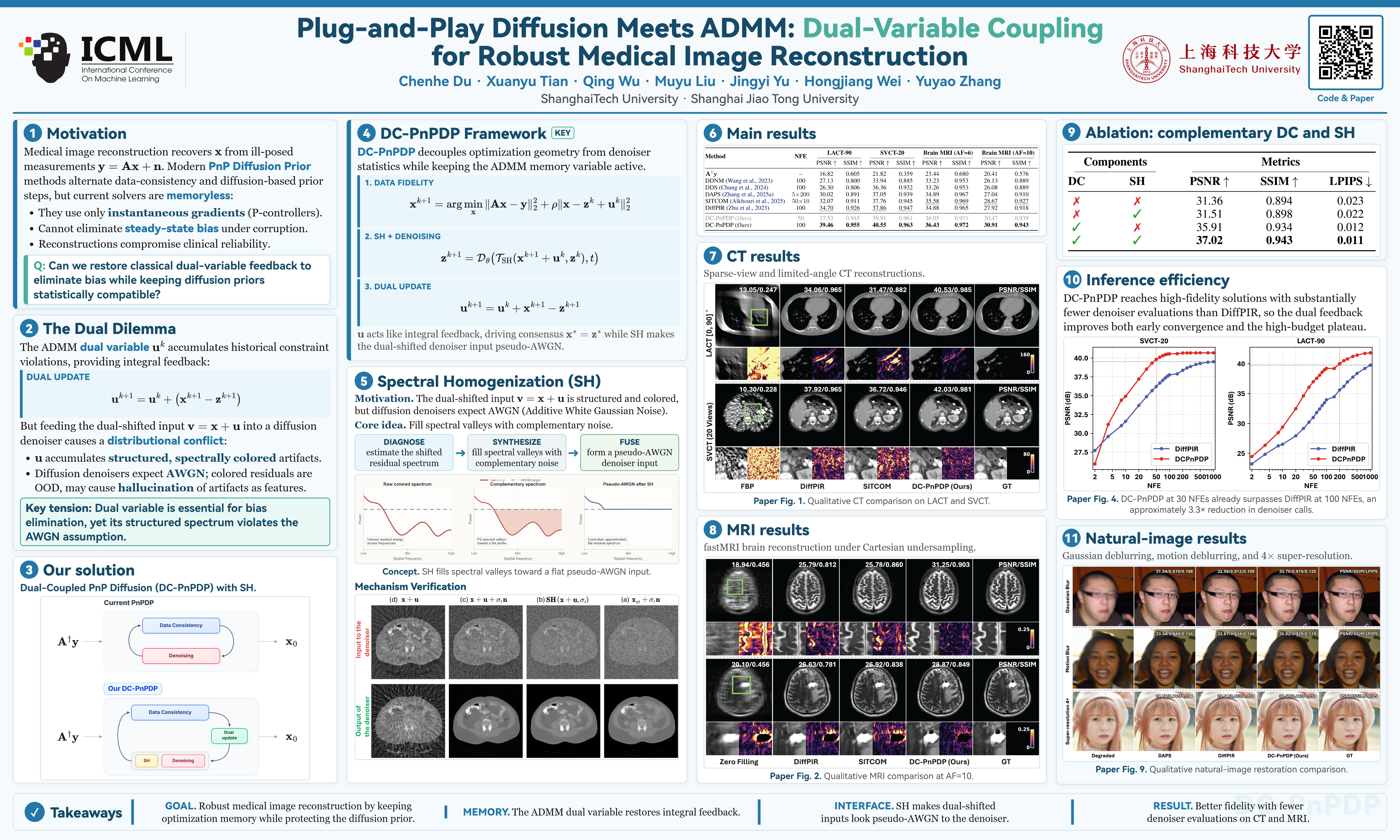
DC-PnPDP: Plug-and-Play Diffusion Meets ADMM: Dual-Variable Coupling for Robust Medical Image Reconstruction
Many plug-and-play diffusion solvers rely on the current gradient without feedback from past errors. Under severe measurement degradation, these memoryless updates can retain data-consistency errors. DC-PnPDP introduces dual-variable feedback from the alternating direction method of multipliers (ADMM). Spectral homogenization adjusts structured residuals to match the diffusion denoiser’s noise assumptions, supporting more robust and faster-converging CT/MRI reconstruction.

DC-PnPDP poster at ICML 2026; click to view the full-resolution original
-
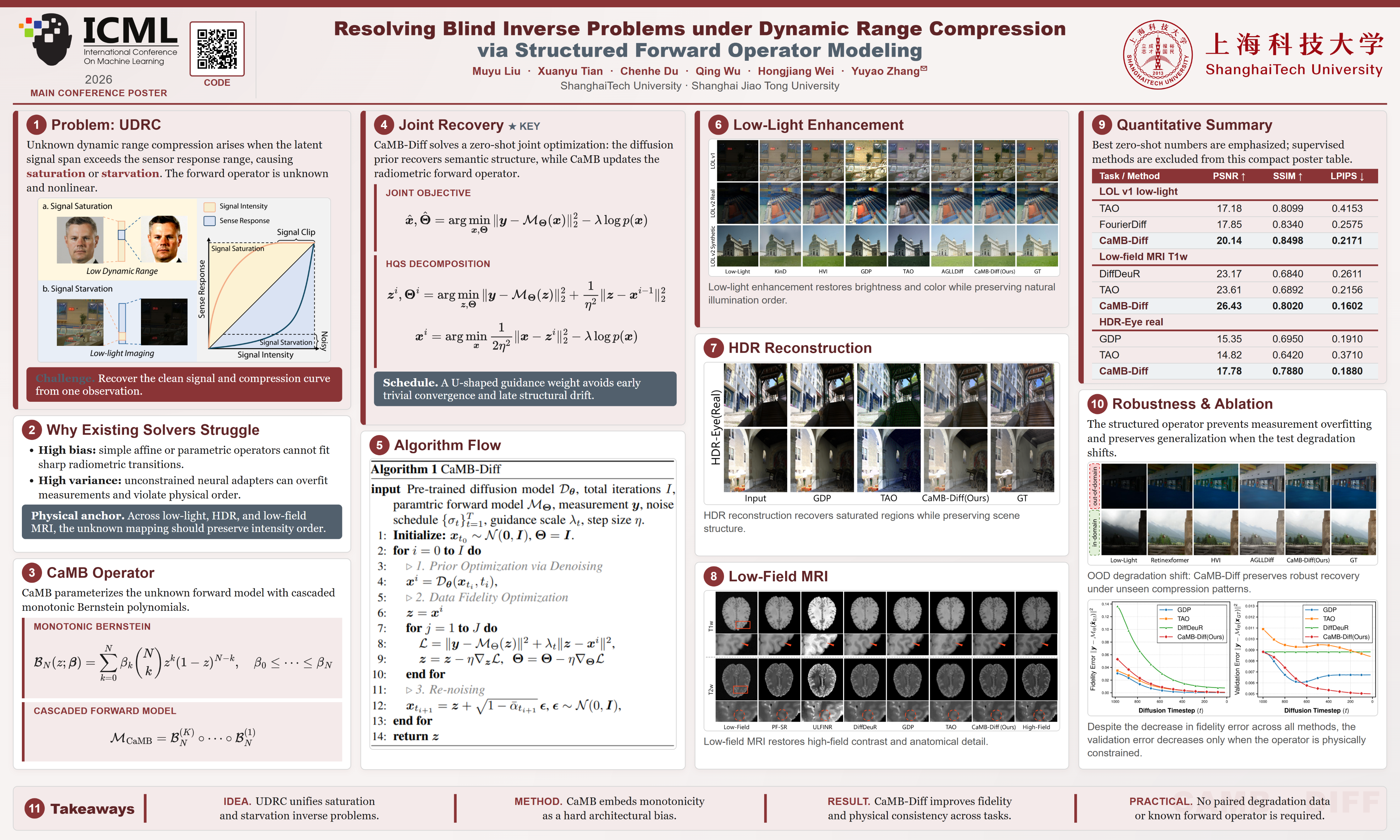
CaMB-Diff treats low-light enhancement, HDR reconstruction, and low-field MRI enhancement as blind inverse problems sharing an unknown dynamic-range compression process. It explicitly models this unknown mapping using a cascaded monotonic Bernstein operator (CaMB), coupled with a plug-and-play diffusion prior. As it restores image structure, the method estimates and corrects intensity distortion, balancing structural detail and intensity fidelity while maintaining consistency with the measurement physics.

CaMB-Diff poster at ICML 2026; click to view the full-resolution original
During poster sessions and conference discussions, both students exchanged ideas with professors and PhD students from Zhejiang University, the Chinese Academy of Sciences, Xi’an Jiaotong University, and other institutions, as well as researchers from the United States, Germany, South Korea, and India. Topics included diffusion models for inverse problems, the relationship between generative priors and classical optimization, and the role of data consistency in reconstruction. These exchanges encouraged them to investigate stability under different degradations and reliability under out-of-distribution data or prior mismatch.
In discussions with researchers at the Technical University of Munich (TUM), both students focused on adapting general-purpose pretrained models to medical imaging and the relationships among model scale, training data, and imaging physics. They emphasized defining the applicability of large pretrained priors across devices, scanning protocols, and pathological distributions and evaluating generalization systematically.
They also spoke with researchers from Ant Group and vivo about foundation models, data organization, and engineering practices. Discussions of computation costs, inference efficiency, and deployment needs informed further improvements to implementation, experimental design, and code standards.
The conference gave both students an opportunity to share the lab’s results with international researchers. They plan to incorporate the feedback into their work and bring the discussions and emerging research directions back to the lab for further exploration with their supervisor and colleagues.
Cover image: ICML 2026 official website.
