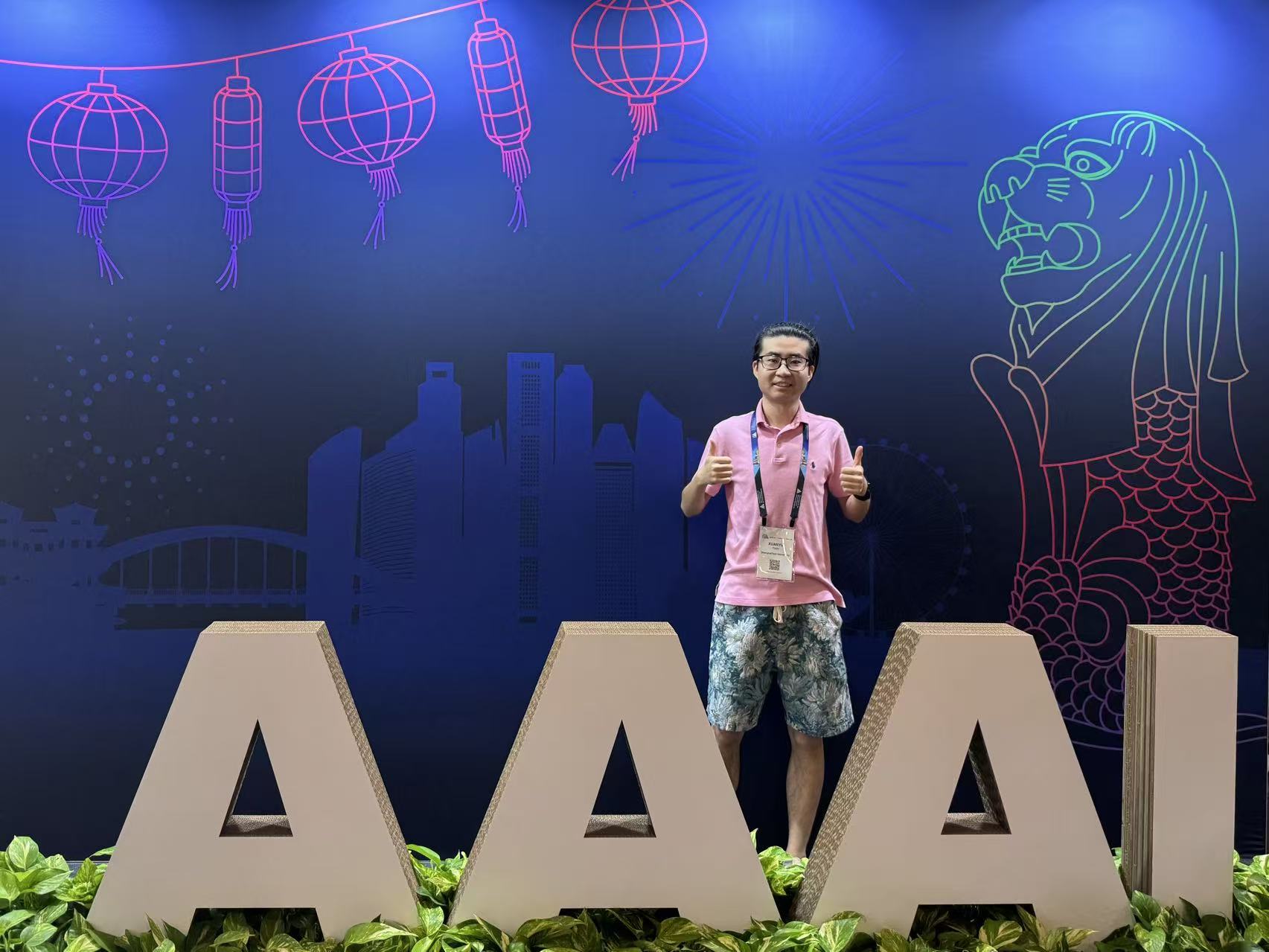
From January 21 to 26, 2026, PhD student Xuanyu Tian attended the 40th AAAI Conference on Artificial Intelligence in Singapore. The visit provided an opportunity to present the lab’s latest medical-imaging reconstruction research and discuss developments in physics-driven deep learning with international researchers.
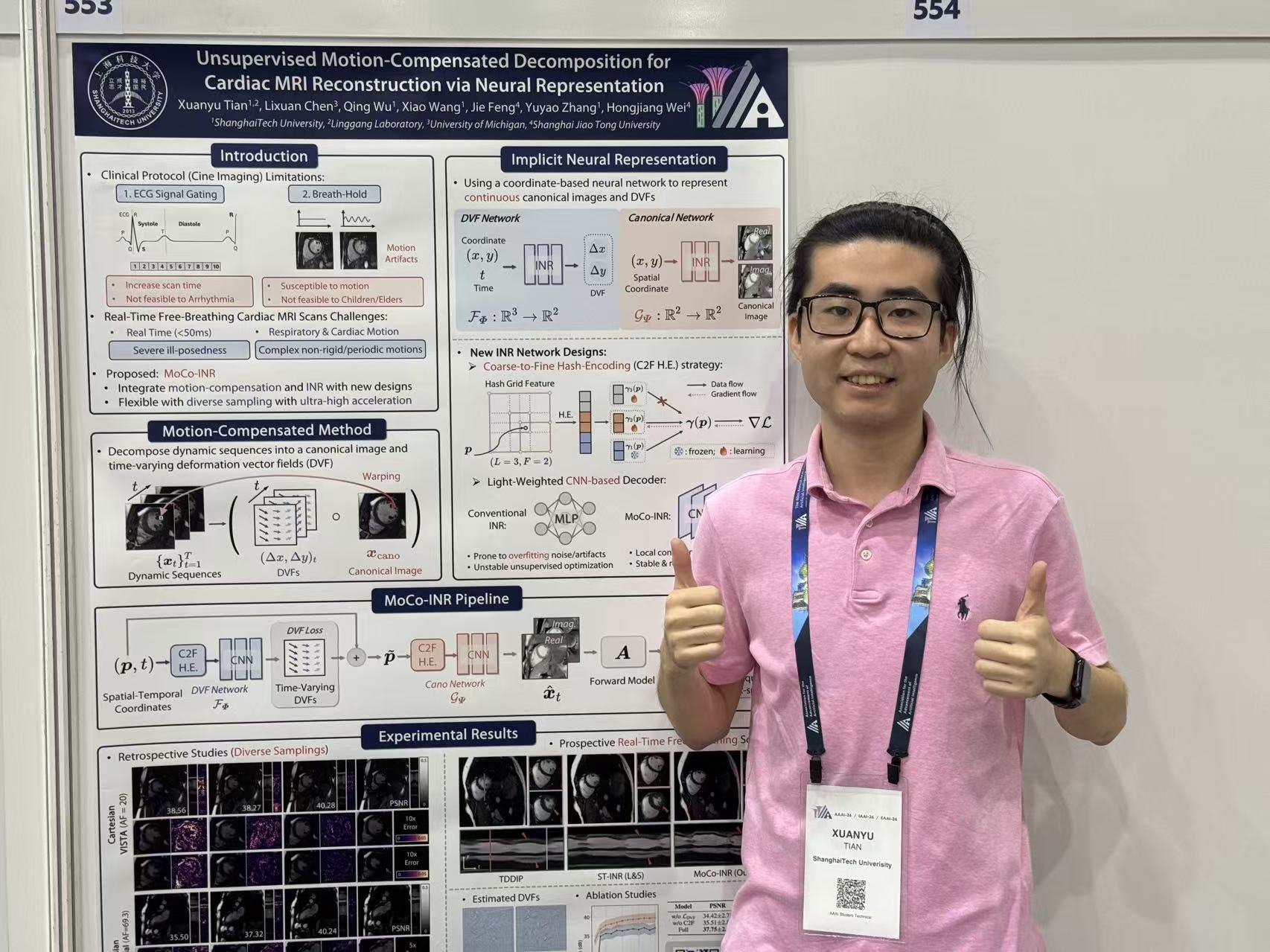
On January 22, Xuanyu presented Unsupervised Motion-Compensated Decomposition for Cardiac MRI Reconstruction via Neural Representation. Traditional cardiac MRI often depends on breath-holding and patient cooperation. This work introduces an unsupervised reconstruction framework combining implicit neural representations with motion-compensated decomposition. By separately modeling cardiac anatomy and respiratory motion, it reconstructs dynamic images without fully sampled data or precise motion labels. Its motion-modeling accuracy and image-detail preservation attracted interest from attendees.
Xuanyu discussed possible combinations of implicit neural representations and diffusion models with PhD researchers from Imperial College London. They exchanged ideas on using generative priors to improve robustness under complex motion and out-of-distribution data, suggesting new directions for future work.
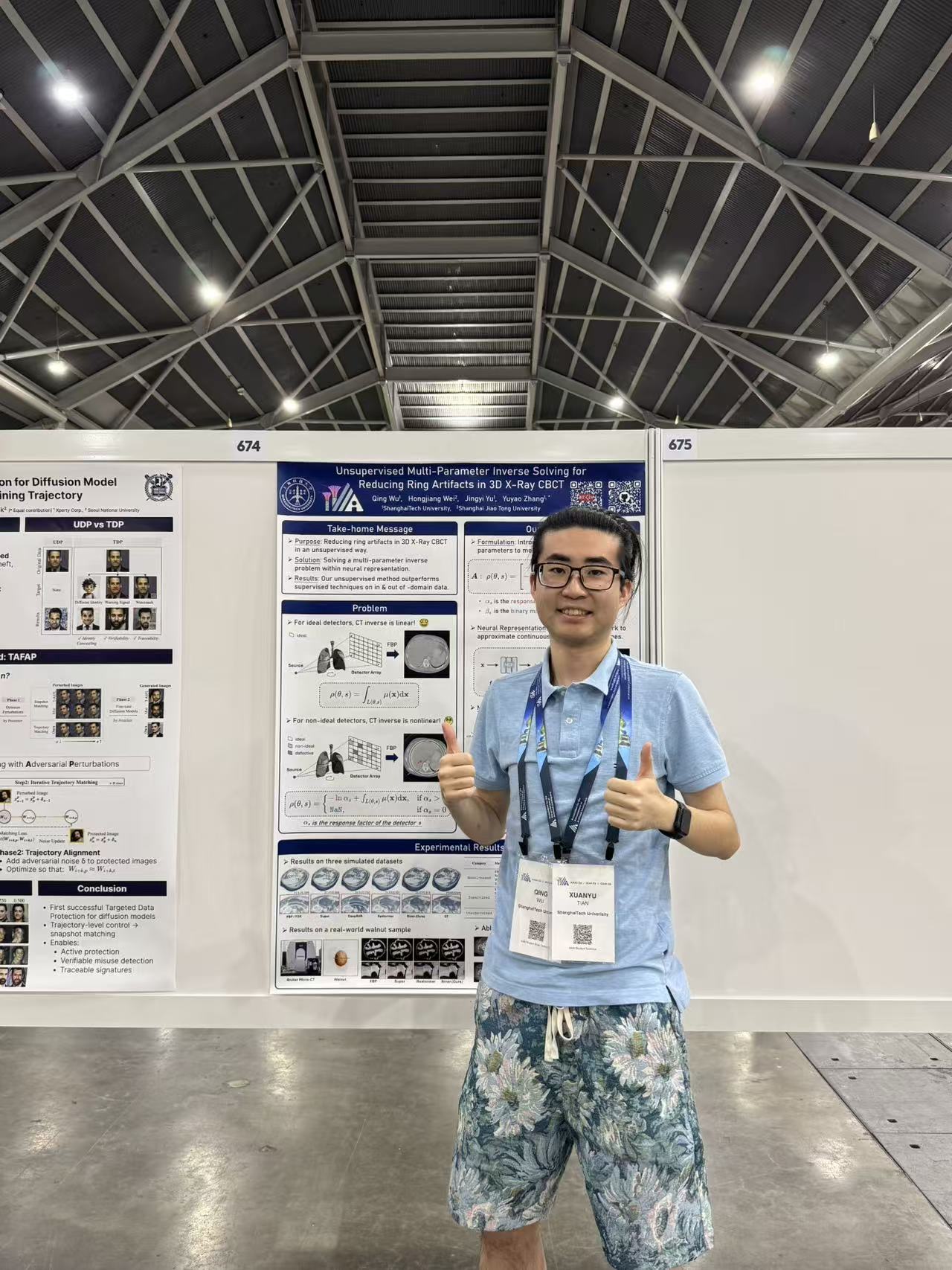
On January 23, Xuanyu presented Unsupervised Multi-Parameter Inverse Solving for Reducing Ring Artifacts in 3D X-Ray CBCT on behalf of lab alumnus Qing Wu. The work addresses ring artifacts caused by inconsistent detector responses in cone-beam CT. Its unsupervised multi-parameter inverse-solving approach couples the imaging physics and artifact-generation process to distinguish artifacts from genuine anatomical structures without additional annotations, improving reconstruction quality while preserving structural information.
During this presentation, Xuanyu discussed the work with researchers from the National University of Singapore and Huawei engineers developing industrial CT reconstruction algorithms. Academic discussions concerned interpretability and generalization in unsupervised modeling. Industry participants emphasized computational efficiency, real-time performance, and stability in low-dose imaging. Their feedback offered useful guidance for adapting the algorithms to clinical and industrial equipment.
The lab will use this feedback to refine its methods, explore efficient and robust reconstruction in real clinical settings, and strengthen collaboration with international researchers and industry partners.
